
Views: 222 Author: Tomorrow Publish Time: 02-02-2026 Origin: Site


Content Menu
● Target Keywords and Search Intent
● Why Powder Detergent Remains a Smart Choice
● Quick Answer: Where to Put Powder Detergent by Machine Type
● How Washing Machines Dispense Powder Detergent
● Step-by-Step: Front-Load Washing Machines
>> 1. Identify the Correct Compartment
>> 2. Add the Powder Detergent
>> 4. Maintenance: Keep the Drawer Clean
● Step-by-Step: Top-Load Washing Machines
>> 1. Using Direct-to-Drum Placement
>> 2. Using Built-In Dispensers
● Step-by-Step: High-Efficiency (HE) Machines
>> 1. Choose HE-Compatible Powder
>> 2. Place Powder in the HE Main Wash Compartment
● Common Mistakes When Adding Powder Detergent
● How Much Powder Detergent Should You Use?
● Advanced Tips for Getting the Best Results with Powder
● Why OEM Brands Should Care About Proper Detergent Placement
● Dongguan UFine Daily Chemical – Your OEM Partner for Powder Detergent
● FAQs About Where to Put Powder Detergent
>> 1. Can I put powder detergent directly into the drum?
>> 2. Is it better to use the detergent drawer or the drum in a front-load washer?
>> 3. Can I use powder detergent in a high-efficiency (HE) washing machine?
>> 4. What should I do if there is powder residue on my clothes?
>> 5. How often should I clean the detergent drawer or dispenser?
As an OEM detergent factory in China, Dongguan UFine Daily Chemical Co., Ltd. helps global laundry brands design products that are easy for end-users to use and hard for them to misuse. Correct powder detergent placement is one of the most important details that affects cleaning performance, customer satisfaction, and machine life.

This guide is optimized around the core keyword “where to put powder detergent in a washing machine” and related long-tail queries such as “where to put detergent in front load washer,” “how to use powder detergent in top-load machine,” and “can you use powder detergent in HE washer.”
Searchers usually want three things:
- A clear answer for their specific machine type (front-load, top-load, or HE).
- Step-by-step instructions that avoid residue, gray clothes, and machine odor.
- Simple guidance on how much powder to use and what kind of detergent is best.
Powder detergent is still a preferred option for many consumers and commercial laundries. As an OEM, positioning powder correctly helps your brand capture value-focused and performance-focused buyers.
- Cost-efficient cleaning: Powder formulas are often more economical per wash than liquid, especially for family and bulk users.
- High stain-removal power: Powders perform especially well on mud, clay, and outdoor dirt, and can help manage mineral-related issues in water.
- Longer shelf life: Powders are more stable in storage and less prone to degradation in hot climates and long supply chains.
- Machine-friendly: When dosed correctly, powder tends to leave less internal residue than some liquids, helping reduce odor and mold risk.
For OEM buyers, this means a reliable hero format you can confidently build your brand around.
Use this as a fast reference for your customers:
| Machine type | Where to put powder detergent | Key notes |
|---|---|---|
| Front-load washer | In the main wash compartment of the detergent drawer, or directly in the drum if the manual recommends it. | Never overfill the drawer; follow symbols on the tray. |
| Top-load washer | Directly into the drum before adding clothes, or in the dedicated dispenser if available. | Let powder mix with incoming water for better dissolution. |
| High-efficiency (HE) washer | In the HE-labeled main wash compartment; use reduced dosage. | Use HE-compatible powder; avoid suds overload. |
Clear diagrams and on-pack icons that reflect this table can dramatically reduce end-user error.
Understanding machine mechanics helps you explain why correct placement matters.
- Detergent drawer systems (common in front-load and some HE models) pull water through each compartment (pre-wash, main wash, softener), rinsing powder into the drum at the right time.
- Direct-to-drum systems (common in top-load) rely on water flow and agitation to dissolve powder around the clothes.
- If powder is dropped on top of dry clothes, it can stick to fabric and fail to dissolve completely, leading to white streaks and customer complaints.
For OEM brands, educating customers on these basics significantly improves the perceived quality of your detergent.
Front-load washers are efficient but more sensitive to over-dosing and drawer clogging.
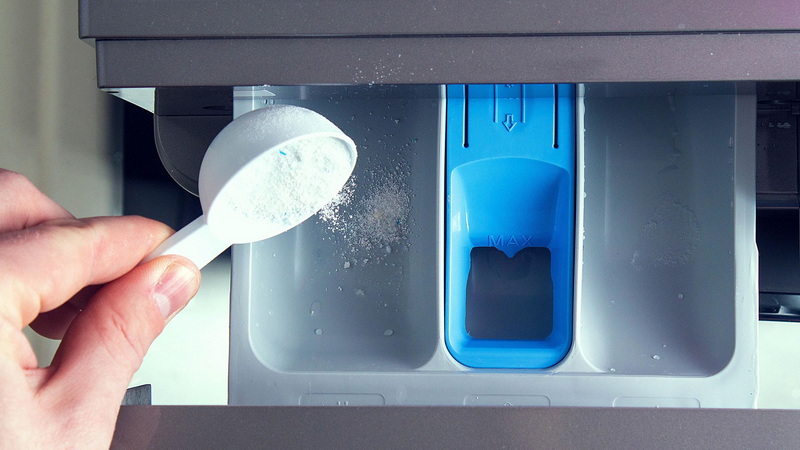
Most detergent drawers have three sections:
- Pre-wash (Tray 1) – often marked “I” or “1”; used for heavily soiled loads that need an extra wash step.
- Main wash (Tray 2) – usually the largest compartment, marked “II” or “2”; this is where most powder detergent should go.
- Softener compartment – usually marked with a flower icon; never put powder here.
Advise users to consult the machine manual if symbols differ between brands.
- Pull out the drawer and locate the main wash compartment.
- Measure the recommended amount of powder according to the package (usually adjusted for water hardness, soil level, and load size).
- Pour the powder evenly into the compartment; avoid piling it over the “max” line to reduce risk of blockages.
Expert tip: If the tray has a removable liquid insert, users must take it out before adding powder; otherwise powder may not dispense correctly.
- Choose a temperature at which your powder is designed to dissolve (often 30–60°C; check on-pack recommendations).
- For frequent cold washes, recommend either a “cold-active” powder or pre-dissolving the powder in warm water before pouring it into the drawer.
- Once a month, ask users to pull out the whole drawer, rinse with warm water, and brush off any caked powder.
- Regular cleaning prevents clogs, mold, and unpleasant odors, all of which customers often blame on the detergent itself.
Top-loaders usually give users more flexibility but can suffer from residue if powder is poured directly on clothes.
- Open the lid and add powder directly into the drum before loading clothes.
- Start filling with water (or let the automatic filling begin), so the powder dissolves as water flows in.
- Then add laundry items and start the cycle. This minimizes undissolved granules sticking to fabric.
Some top-load models have a dedicated powder detergent dispenser mounted in the lid or on the drum wall.
- Instruct users to add powder into this dispenser up to the indicated line, then close it.
- Water will flush the powder out at the correct time in the cycle.
OEM advice: Adding a simple diagram on your packaging that shows “Top-load – powder to drum first” or “Use top dispenser if available” reduces misuse and support queries.
HE machines use less water and gentler action, so dosing and placement are more critical.
- Always label OEM products clearly as HE compatible when the formulation is low-sudsing and suitable for high-efficiency washers.
- Excess suds in HE machines can cause poor rinsing, extended cycles, and even error codes.
- Add powder to the main wash compartment marked for detergent, often labeled “HE” or with a specific icon.
- Never put powder into the softener tray or bleach compartment.
- Because HE machines use less water, less detergent is needed per load compared to standard machines.
- Encourage users to start at the lower end of your recommended range, then adjust slightly based on soil level and water hardness.
Helping users avoid these mistakes protects both your brand reputation and their machines.
- Using too much detergent: Over-dosing wastes product, leaves residue on clothes, and can cause foam and odor build-up inside the washer.
- Pouring powder directly on dry clothes: This increases the risk of undissolved particles and fabric streaking, especially in cold water.
- Ignoring water temperature: Many standard powders dissolve best in warm or hot water; using them in cold cycles without pre-dissolving can reduce cleaning power.
- Never cleaning the detergent drawer or dispenser: Build-up in these areas leads to clogs, leaks, and bad smells.
For OEM marketing, turning these into simple checklists or infographic panels on your website and packaging is highly effective.
While exact dosage should always follow your brand's technical recommendation, customers look for simple rules.
- Follow the package first: Your dosage table should clearly state recommended scoops for light, normal, and heavy soil and for different water hardness levels.
- Factor in load size: Full drum loads with heavily soiled clothing legitimately need more powder; half loads may need significantly less.
- Watch for residue or dullness: If clothes feel slimy or show white streaks, users should slightly reduce powder; if they come out gray or still dirty, increase gradually.
An easy visual guideline on pack (for example, “¼ scoop – small load; ½ scoop – normal; ¾ scoop – heavily soiled”) supports both user satisfaction and long-term loyalty.
These extra steps can differentiate your brand's how-to content from competitors.
- Pre-dissolve for stubborn stains or cold washes: Mix powder in a jug of warm water, then pour the solution into the drawer or drum.
- Use pre-wash only when needed: Reserve pre-wash cycles and powder in the pre-wash tray for very dirty workwear or sports gear.
- Balance machine load: Avoid overloading; clothes need space to move so the detergent solution can reach every fiber.
- Check fabric care labels: Some delicate fabrics prefer lower temperatures or special cycles; align powder use with these instructions.
These points are ideal places to insert small icons or mini-illustrations in your blog layout.
For OEM buyers, teaching correct powder placement is not just about user education; it is a direct lever for brand differentiation and reduced complaints.
- Fewer “white residue” or “bad smell” issues means fewer support tickets and returns.
- Clear on-pack diagrams and QR codes linking to this kind of guide build trust and perceived professionalism.
- Correct dose and placement ensure your formulation performs at its designed level, showcasing the real quality of your powder.
Integrating this guidance into your private-label design service for overseas distributors and laundry brands adds visible value to every product you launch.
As a specialized Chinese OEM detergent manufacturer, Dongguan UFine Daily Chemical Co., Ltd. develops and produces powder detergents tailored to global market demands.
- Custom formulations: From standard household powders to high-efficiency, low-sudsing, and cold-water-active variants for different regions.
- Flexible packaging: Bags, boxes, and bulk sacks with custom artwork, usage diagrams, and multilingual instructions.
- Quality and compliance: Production that meets international standards and supports distributors with consistent quality and documentation.
If you are a detergent brand owner, wholesaler, or importer, we can help you launch or upgrade your powder detergent line with optimized user guidance and performance.
If you want to develop or improve your own powder detergent brand and provide customers with detergent that is both powerful and easy to use, now is the time to act.
Contact Dongguan UFine Daily Chemical Co., Ltd. today to discuss custom formulations for front-load, top-load, and HE markets, along with tailored packaging and on-pack usage instructions. Share your target market, product positioning, and budget, and our team will design a complete OEM solution that enhances washing performance, reduces customer complaints, and strengthens your brand in the global laundry care market.
Contact us to get more information!
Yes, you can add powder directly to the drum of most top-load washers, ideally before putting in clothes so the powder dissolves in the incoming water. In some front-load models, the manufacturer also allows drum dosing, but users should check the machine manual first.
For most front-load machines, using the main wash compartment in the drawer is recommended because the washer is designed to flush detergent in at the right time. Some brands also support drum dosing for fast dissolving, but only when the product and manual explicitly allow it.
Yes, you can use powder in HE machines as long as the formula is HE compatible and low-sudsing. Always use less detergent than in a standard washer and place it in the HE main wash compartment, not the softener tray.
First, reduce the detergent amount slightly and avoid pouring powder directly on dry clothes. Then, wash at a slightly higher temperature or pre-dissolve the powder in warm water before adding it to the drawer or drum.
A simple monthly cleaning with warm water is usually enough for regular home use, while heavy users may need to do it more frequently. Removing caked powder prevents clogs, bad smells, and poor detergent flow into the drum.
1. https://tide.com/en-us/our-commitment/americas-number-one-detergent/our-products/powder-detergent/how-to-use-powder-detergent
2. https://www.all-laundry.com/laundry-tips/washing-101/how-to-use-powder-detergent.html
3. https://ggfmcg.com/our_stories/use-detergent-powder-for-washing-machines
4. https://www.persil.com/uk/laundry/laundry-tips/washing-tips/where-do-you-put-detergent-in-a-washing-machine.html
5. https://speedqueeninvestor.com/user-tips/where-should-the-detergent-go-in-the-machine/
6. https://stppgroup.com/the-ultimate-guide-to-using-washing-powder-dosage-tips-and-more/
7. https://producthelp.whirlpool.com/Laundry/Washers/Product_Info/Washer_Tips_and_Tricks/Using_Powder,_Liquid,_or_Single_Dose_Pod_Detergent
8. https://www.realsimple.com/when-to-use-liquid-vs-powder-laundry-detergent-11843652


