
Views: 222 Author: Jessica Chen Publish Time: 03-04-2026 Origin: Site


Content Menu
● Understanding Laundry Pods from a Technical OEM Perspective
>> What is inside a modern laundry pod?
>> PVA water‑soluble film: the "smart skin" of the pod
● Child Safety Risks: What the Data and Real Cases Tell Us
>> Why young children are at higher risk
● Safety‑First Design: How We Engineer Safer Laundry Pods
>> Child‑resistant and less attractive packaging
>> Visual and sensory design that does not target children
>> Clear on‑pack warnings and emergency guidance
● Safe Storage and Use: What We Recommend Brands Teach Their Customers
>> Safe storage checklist for families
>> Correct use in the washing machine
● What to Do If a Child Is Exposed to Laundry Pods
>> Practical "first 3 steps" guidance
● How We Support Global Brands with OEM Laundry Pods
>> Our OEM capabilities at a glance
>> Documentation and compliance support
● Why Overseas Partners Choose Our Factory for Laundry Pods OEM
● Call to Action: Build Your Next Laundry Pods Line with a Safety‑Driven OEM Partner
● FAQs About OEM Laundry Pods and Safety
As an OEM laundry pods manufacturer in Dongguan, China, we sit right at the intersection of chemistry, engineering, and product safety. Every day, we help overseas brands, importers, and private‑label owners turn ideas into real detergent pods that must clean effectively, pass regulations, and stay safe in family homes. [ufinechem]
In this expert guide, we share how we design and produce laundry detergent pods from an OEM factory perspective: from PVA water‑soluble film and concentrated formulas to child‑safety measures, compliance, and what global partners should look for when choosing a manufacturer.

Most consumers see pods as colorful "jelly balls" that magically wash clothes. As a factory, we see a precisely engineered unit-dose system: a high‑concentration detergent enclosed in a functional polymer film that must dissolve on demand. [polyva-machine]
A typical pod we produce for our clients usually contains:
- Anionic and nonionic surfactants for soil removal and emulsifying oils and grease. [stppgroup]
- Builders and chelating agents to bind calcium and magnesium in hard water and prevent scale.
- Enzymes such as protease, amylase, and lipase to break down protein, starch, and fat‑based stains.
- Polymers to prevent redeposition, plus brighteners, fragrance, and colorants as required.
Because pods are designed as concentrated products, the level of active ingredients per milliliter is significantly higher than in regular liquid detergents. This is excellent for cleaning power and logistics efficiency, but it also means a small amount of liquid can be irritating if swallowed or splashed into the eyes—especially for children.
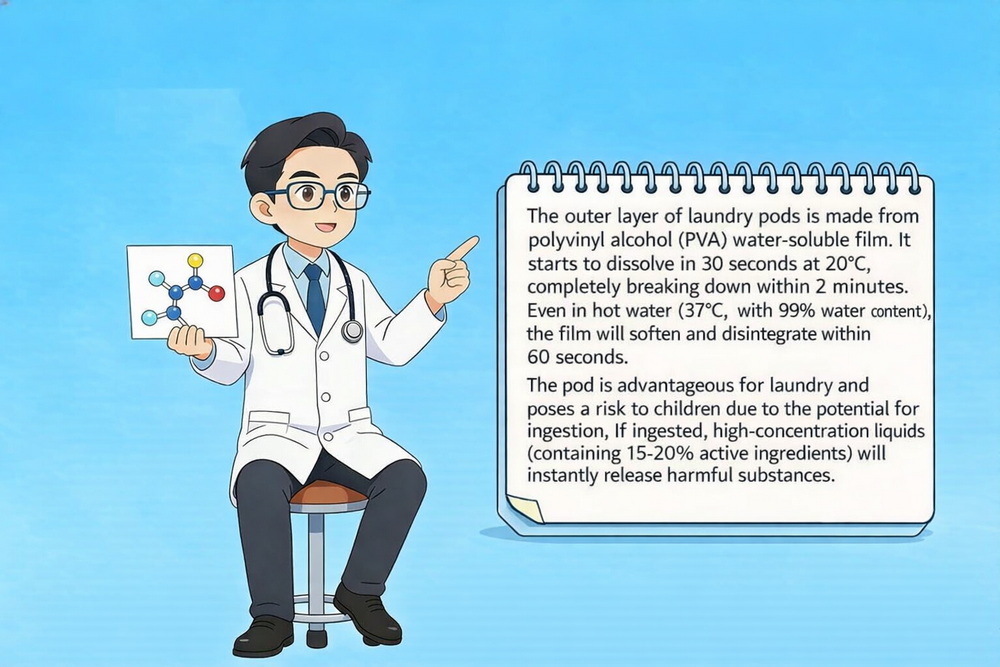
The outer film of pods is typically made from polyvinyl alcohol (PVA), a water‑soluble polymer used not only in detergents but also in medical and pharmaceutical fields. Detergent‑grade PVA film is engineered to: [prod-us-en.tide]
- Dissolve quickly at common wash temperatures, even in 20–30 °C cycles.
- Remain stable during storage, transportation, and normal handling.
- Be compatible with alkaline formulas and active ingredients in the pod.
In a washing machine, the PVA film starts to soften within seconds and ruptures within a few minutes, releasing the inner liquid. In a child's mouth, warm saliva can trigger a similar rapid dissolution, which is why the combination of concentrated liquid and fast‑dissolving film creates a specific pediatric safety risk if a pod is chewed or bitten. [nationwidechildrens]
From an OEM manufacturer's standpoint, child safety is the most sensitive risk area for laundry pods. International surveillance data and hospital reports show that pediatric exposures to detergent packets are a global concern, not limited to any single country. [injuryprevention.bmj]
Several patterns appear consistently across regions:
- Most exposure cases involve children under 5 years old, especially toddlers who are curious and explore the world by touching and biting. [pmc.ncbi.nlm.nih]
- Pods often look like candies or jelly snacks due to bright colors and transparency, which increases the temptation to play or taste. [nationwidechildrens]
- Once bitten, the PVA film can rupture rapidly in the mouth and release a highly concentrated mixture of surfactants, enzymes, and other chemicals. [stppgroup]
Clinical reports describe symptoms ranging from vomiting and eye irritation to respiratory problems, especially when detergent is accidentally aspirated into the lungs. This is why safety organizations and leading brands heavily emphasize storage, packaging, and caregiver education for pods. [cdc]

For us, pods are not just "convenient detergent." They are a high‑consequence product: the absolute number of incidents may be small compared to total sales, but the potential impact on a child and on a brand's reputation is significant. That is why we build safety thinking into formulation, film, packaging, labeling, and partner education from the very beginning. [ufinechem]
When overseas brands ask how to make pods "safe," the honest answer is that no product is 100% risk‑free in the wrong hands. What we can do is systematically reduce the risk through engineering and design decisions across multiple layers. [ufinechem]
We strongly recommend that our OEM partners choose packaging that combines child‑resistance with clear warnings:
- Tubs with press‑and‑twist or two‑step opening mechanisms that are difficult for small children to operate. [cdc]
- Opaque or semi‑opaque containers that do not display the pods like candy in a jar.
- Reinforced zip pouches with double‑seal and high opening points, especially for cost‑sensitive projects.
Regulatory guidance and safety campaigns also encourage avoiding purely decorative transparent canisters that showcase pods like colorful sweets on kitchen counters. [tide]
*Suggested image position*: Lifestyle photo comparing safe storage (opaque, high shelf) vs unsafe storage (clear jar within child reach), with clear caption.
As a manufacturer, we see how strong visual design can increase sales—but also attract toddlers. Our expert recommendations include:
- Avoiding fruit or cartoon shapes that directly mimic food or toys.
- Using more muted colors and fewer candy‑like, jelly‑clear combinations.
- Limiting overly sweet, candy‑type fragrances on family products.
Where allowed, incorporating bittering agents can create an unpleasant taste if a pod is bitten, helping children spit it out quickly instead of swallowing. This is a last barrier, not a replacement for proper packaging and storage.
We work with our clients to add simple but strong safety language, for example:
- "Keep out of reach of children."
- "Store locked up and in original container."
- "Do not pierce or cut pods."
- Basic first‑aid instructions for skin, eye, and ingestion exposures in line with poison control and medical guidance. [cdc]
This supports both regulatory compliance and real‑world safety at home.
Even the best‑engineered pods can be misused if end users lack clear instructions. We therefore help overseas partners create practical, easy‑to‑understand usage guides for packaging, manuals, and Amazon product pages. [ufinechem]
We encourage brands to highlight three simple household rules:
1. Store high and locked
Keep pods in a cabinet at least 1.5 m above the floor, ideally with a lock or child‑safety latch, and never next to snacks or toys.
2. Store in original packaging
Do not transfer pods into glass jars, bowls, or decorative containers. Original packaging is designed to close securely and includes safety labels and emergency information. [nationwidechildrens]
3. Use and put away immediately
Take out the required pods, close the container firmly, and return it to the storage area before starting the washing machine.
To reduce complaints and ensure optimal performance, we advise brands to communicate:
- Place pods in the back or bottom of the drum before loading laundry, never in the dispenser drawer. [prod-us-en.tide]
- Use the number of pods specified on the label depending on load size and soil level (for example, 1 pod for normal loads, 2 pods for very large or heavily soiled loads).
- Avoid cutting or pre‑dissolving pods in water; let the PVA film dissolve naturally during the wash. [stppgroup]

User feedback and case studies show that caregivers often panic and make mistakes, such as forcing vomiting or giving random home remedies. We help our OEM partners share clear, calm, evidence‑based steps with consumers. [nationwidechildrens]
1. Identify the contact type
- Skin: Rinse thoroughly with running water for at least 15 minutes. [cdc]
- Eyes: Rinse carefully with clean water for 15 minutes; remove contact lenses if easy to do.
- Mouth (not swallowed): Rinse the mouth several times with water; do not force large volumes of liquid.
2. Avoid harmful actions
- Do not induce vomiting, as this can increase the risk of detergent entering the lungs. [nationwidechildrens]
- Do not give milk, vinegar, or home medications without professional advice.
3. Seek professional help immediately
- If detergent has been swallowed or inhaled, or if the child shows breathing difficulty, vomiting, or unusual drowsiness, contact local emergency services or poison control at once. [cdc]
- Bring the product package to the hospital so medical staff can quickly see the ingredients and hazard symbols.
As an OEM manufacturer, we are not a medical authority, but we consider it our responsibility to help brands communicate this essential information clearly and consistently.
Beyond safety and chemistry, brand owners need reliability, documentation, and flexibility from their OEM partner. [ufinechem]
- Custom formula development (stain removal focus, sensitive‑skin variants, fragrance profiles, color‑care, etc.). [ufinechem]
- Single‑chamber and multi‑chamber pods, including separate compartments for enzymes, oxygen bleach, or softener.
- Multiple pack formats: tubs, stand‑up pouches, and carton plus inner bag combinations.
- Stability and performance testing to fit different water hardness and washing habits in global markets. [ufinechem]
We regularly provide our partners with:
- Safety Data Sheets (SDS) and ingredient lists compatible with GHS / CLP labeling requirements. [stppgroup]
- Test reports for PVA film dissolution, storage stability, and washing performance.
- Guidance on hazard statements, precautionary statements, and icon usage for packaging and Amazon listings.
For Amazon FBA sellers, supermarket private labels, or regional brands, having a factory that understands both formulation and compliance language can save a great deal of time and risk.
From feedback and long‑term cooperation, we see a few recurring reasons why international partners stay with our OEM service. [ufinechem]
| Partner priority | How we respond as OEM manufacturer |
|---|---|
| Strong cleaning performance | Concentrated formulas tailored to local washing habits.ufinechem |
| Safety and child‑risk mitigation | Packaging options, on‑pack guidance, and safety documentation. [nationwidechildrens] |
| Regulatory peace of mind | SDS, ingredient lists, and test reports aligned with global norms.ufinechem |
| Flexibility in customization | Wide choice of dosages, shapes, colors, and fragrances.ufinechem |
| Long‑term partnership and support | Fast sampling, stable lead times, and responsive technical support. |
In simple terms, we do not just "fill pods"; we help you design a market‑ready, compliant, and safer laundry pods line that can win trust on Amazon, in supermarkets, and in offline retail.
If you are planning to launch or upgrade a private‑label laundry detergent pods line for global markets, we can support you from concept and formula design to packaging, compliance, and mass production. [ufinechem]
Share your target country or region, positioning (eco, family, premium, sensitive skin), desired pod dosage and shape, and packaging idea, and our team will prepare tailored samples and a detailed OEM proposal. Together, we can turn safer, high‑performance pods into a real competitive advantage for your brand.
1. Are laundry pods safe for households with children?
Laundry pods can be used safely in homes with children if brands provide child‑resistant packaging, clear warnings, and storage education such as "store high and locked, in original packaging, and put away immediately after use." However, no product is fully child‑proof, so caregiver vigilance is always required. [cdc]
2. Does PVA film from pods create microplastics?
Detergent‑grade PVA films used in pods are designed to dissolve fully and biodegrade under typical wastewater treatment conditions, and current evidence does not show that pod films persist as microplastics in the environment. This is different from solid plastics that fragment and accumulate in oceans and rivers. [cleaninginstitute]
3. How many pods should consumers use per wash?
Most products are designed for 1 pod per standard load and 2 pods for very large or heavily soiled loads, but the exact recommendation depends on formula strength and local water hardness. Clear on‑pack icons and wording help prevent both under‑dosing and over‑dosing. [ufinechem]
4. What should a caregiver do if a child bites a pod?
Caregivers should rinse the child's mouth with clean water, avoid inducing vomiting, and seek professional medical or poison control advice immediately, especially if any detergent may have been swallowed or inhaled. Taking the product package to the hospital helps doctors see the ingredients quickly. [nationwidechildrens]
5. What should brands look for when choosing an OEM laundry pods manufacturer?
Key points include proven pods experience, strong quality control, ability to provide SDS and regulatory support, flexible formula and packaging customization, and a serious attitude toward child safety and risk communication. A factory that understands both chemistry and compliance can significantly reduce launch risk and long‑term liability. [ufinechem]
1. Dongguan UFine Daily Chemical Co., Ltd. – Company profile and OEM services. <https://www.ufinechem.com> [ufinechem]
2. UFine – "Is Laundry Detergent Pod Safe?" safety and OEM insight article. <https://www.ufinechem.com/is-laundry-detergent-pod-safe.html> [ufinechem]
3. UFine – OEM Laundry Pods product information. <https://www.ufinechem.com/laundry-pods.html> [ufinechem]
4. Tide – "The Water-Soluble Film Surrounding Tide PODs." <https://prod-us-en.tide.com/en-us/our-commitment/americas-number-one-detergent/our-products/laundry-pacs/water-soluble-film> [prod-us-en.tide]
5. Cleaning Institute – "Get the facts about PVA and detergent pods." <https://www.cleaninginstitute.org/get-facts-about-pva-and-detergent-pods> [cleaninginstitute]
6. Kuspis et al. "Surveillance of paediatric exposures to liquid laundry detergent pods." Injury Prevention, 2018. <https://injuryprevention.bmj.com/content/24/1/5> [injuryprevention.bmj]
7. Clinical review on pediatric injuries and poisonings associated with detergent packets. <https://pmc.ncbi.nlm.nih.gov/articles/PMC11238368/> [pmc.ncbi.nlm.nih]
8. Nationwide Children's Hospital – "New Study Finds Laundry Detergent Pods a Serious Poisoning Risk for Young Children." <https://www.nationwidechildrens.org/newsroom/news-releases/2014/11/new-study-finds-laundry-detergent-pods-a-serious-poisoning-risk> [nationwidechildrens]
9. CDC – "Health Hazards Associated with Laundry Detergent Pods." <https://www.cdc.gov/mmwr/preview/mmwrhtml/mm6141a1.htm> [cdc]
10. POLYVA – Laundry pods water‑soluble PVA film product information. <https://www.polyva-machine.com/laundry-pods-water-soluble-pva-film-for-packing.html> [polyva-machine]
11. Water‑soluble film manufacturer – Technical overview of laundry pods films and applications. <https://watersolublefilm.com/products/> [watersolublefilm]
12. STPP Group – "The Science and Safety of Laundry Detergent Pods: A Comprehensive Guide." <https://stppgroup.com/the-science-and-safety-of-laundry-detergent-pods-a-comprehensive-guide/> [stppgroup]


