
Views: 213 Author: Jessica Publish Time: 09-23-2026 Origin: Ufine Daily Chemical


Content Menu
● Start with the customer, not the fragrance trend
>> Turn reviews into a scent brief
● Choose a scent direction that fits the product
● Evaluate fragrance in the finished capsule
>> Use a repeatable sensory test
>> Test for formula and packaging compatibility
● Decide how strong the scent should be
● Consider fragrance sensitivity and claims carefully
● Use a launch process that reduces rework
● What to include in an OEM fragrance brief
● Suggested images, charts, and video
>> 1. What is the best fragrance for laundry detergent capsules?
>> 2. Should a new brand launch with one fragrance or several?
>> 3. How can I tell whether a fragrance is too strong?
>> 4. Can I use "hypoallergenic" or "safe for sensitive skin" on the label?
>> 5. What documents should I request for a fragrance?
>> 6. Why test fragrance in the finished capsule instead of choosing from a scent strip?
*Editor's note: The supplied brief includes a topic title but no original article or customer reviews. This guide therefore does not invent customer quotations or present individual preferences as survey findings. It combines practical product-development guidance with clearly identified formulation considerations.*
Choosing a fragrance for laundry detergent capsules is not simply a matter of picking a pleasant scent. The fragrance needs to suit the target market, remain compatible with the detergent formula and water-soluble film, and smell appealing from dosing through drying. For private-label brands, getting those details right can shape product reviews, repeat purchases, and brand identity.
As an OEM manufacturer, Dongguan Ufine Daily Chemical Co., Ltd. works with brand owners, wholesalers, and manufacturers on laundry capsules and other household cleaning products. From a product-development perspective, the most reliable way to choose a fragrance is to start with the customer and product brief, then evaluate scent in the finished product—not just from a fragrance blotter.
This guide explains how to select a laundry detergent capsule fragrance, compare popular scent directions, assess fragrance performance, and prepare a useful brief for an OEM supplier.
A fragrance that performs well in one market may not suit another. Before selecting notes, define who the product is for and where it will be sold.
Consider:
- Target customer: Families, fragrance enthusiasts, minimalists, or shoppers seeking fragrance-free products.
- Use occasion: Everyday laundry, sportswear, bedding, baby clothing, or premium garment care.
- Retail position: Value, mass market, premium, sensitive-use positioning, or a specialist niche.
- Local preferences: Familiar scent associations and intensity expectations vary by market.
- Product format: A capsule's concentrated detergent system is different from a separate perfume or fabric spray.
Treat these as questions to test, not assumptions about an entire country or demographic. If you have customer feedback, organize it by market, age group, use case, and preferred intensity. Keep exact customer wording separate from your interpretation. That makes it easier to distinguish a recurring preference from an isolated comment.
Customer feedback can be useful when translated into specific product decisions. For example:
| Customer feedback | Possible implication to investigate |
|---|---|
| “The smell is too strong” | Test a lower fragrance level or a softer scent profile |
| “It smells nice in the wash but disappears” | Assess fragrance perception on dry fabric and after storage |
| “It smells like perfume, not clean laundry” | Test a fresher, less overtly perfumed direction |
| “I prefer no scent” | Consider a fragrance-free version, with appropriate claims and review |
| “It leaves an odd smell on towels” | Test the finished formula on relevant fabric and wash conditions |
These are examples of how to interpret comments—not claims about actual reviews of your products. Confirm the cause through testing before changing the fragrance or formula.
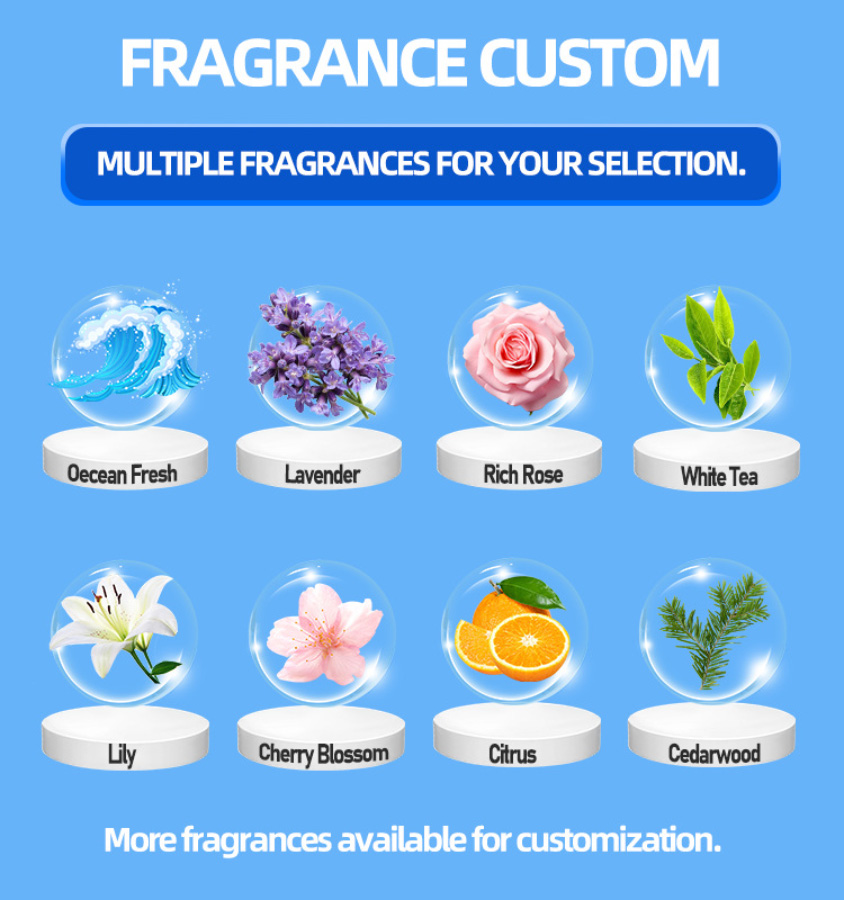
Most laundry fragrance briefs can start with a few broad directions. These are useful as creative starting points, not guarantees of consumer preference.
| Scent direction | Typical impression | Often worth testing for |
|---|
| Scent direction | Typical impression | Often worth testing for |
|---|---|---|
| Fresh and clean | Light, airy, crisp | Everyday or broad-appeal positioning |
| Citrus | Bright, zesty, energetic | A fresh-clean concept or warm-weather launch |
| Floral | Soft, familiar, expressive | Brands seeking a more perfumed identity |
| Herbal or green | Crisp, botanical, restrained | A contemporary or understated concept |
| Woody or musk | Warm, smooth, lingering | A premium-feeling fragrance direction |
| Fragrance-free | No added scent | Customers who prefer to avoid fragrance |
Build a shortlist of two or three scent directions. For each one, agree on the intended intensity, character, and fabric impression. "Fresh" alone is too vague. A more useful brief might say: "light, crisp, low sweetness, with a clean impression after drying."
Avoid relying on names such as "ocean breeze" or "spring blossom" as the brief itself. Product names describe a marketing idea; they do not tell a formulator what the fragrance should smell like or how it should perform.
A fragrance can smell different in a bottle, on a test strip, in concentrated detergent, and on washed fabric. The finished capsule is the relevant product. Its ingredients, packaging, storage, dosage, wash conditions, and drying method can all affect the experience.
A practical early-stage evaluation can follow these steps:
1. Compare fragrance samples blind. Assign codes rather than displaying fragrance names.
2. Use the same detergent base and dose. Keep the test conditions consistent.
3. Wash comparable fabrics. Include materials relevant to the intended use, such as cotton towels or everyday clothing.
4. Assess multiple stages. Smell the product as supplied, the wash solution if appropriate, and the fabric after washing and drying.
5. Record intensity and character separately. A scent can be pleasant but too strong—or subtle but difficult to identify.
6. Repeat before deciding. One test load may not represent the product's performance across conditions.
A simple evaluation sheet can ask testers to rate pleasantness, perceived intensity, freshness, distinctiveness, and willingness to use again. Include an open-ended question, such as "What does this remind you of?" Do not treat a small informal panel as representative of the whole market. Use it to identify candidates for more structured testing.
Fragrance evaluation is also a technical exercise. Ask the OEM formulator to assess candidate fragrances in the actual detergent system and capsule construction.
Review:
- Compatibility with the detergent formula: Confirm the fragrance can be incorporated into the proposed formulation.
- Appearance and stability: Check for unwanted changes in color, clarity, or odor over an agreed storage period.
- Capsule integrity: Evaluate the finished product and its packaging under relevant storage and transport conditions.
- Fragrance consistency: Compare samples from different production batches using an agreed sensory protocol.
- Finished-product performance: Assess the fragrance in the intended wash and drying conditions.
Do not assume a fragrance oil is suitable just because it smells appealing on a blotter. Supplier information can help shortlist candidates, but the finished formula needs its own assessment. A fragrance supplier's own product guidance likewise emphasizes testing scent stability and performance in the customer's formula before bulk production. [yincheefragrance](https://yincheefragrance.com/products/laundry-detergent-fragrance-oils)
"Long-lasting" and "strong" are not the same thing. A fragrance can be clearly noticeable when a package is opened but feel overpowering on clothing. Another can be subtle in the wash yet pleasant on dry fabric.
Define the desired experience in ordinary language:
- Low intensity: Barely noticeable after drying.
- Moderate intensity: Clearly fresh, without dominating the fabric.
- High intensity: Prominent fragrance for customers who actively prefer a stronger scent.
These labels are starting points for discussion, not universal measurements. Ask your formulator to link the target to a controlled test and the relevant fragrance level in the finished formula. Avoid marketing promises such as "lasts for weeks" unless you have evidence from an appropriate test method and can substantiate the claim in the markets where the product will be sold.
Not every laundry customer wants scented products. A fragrance-free option may make sense for a brand's portfolio, but "fragrance-free," "unscented," and similar terms can have different meanings in different markets. Do not use claims such as hypoallergenic, non-irritating, or safe for sensitive skin without suitable evidence and regulatory review.
For products sold in the European Union, fragrance-allergen labeling rules are subject to regulation, and requirements may change. The European Commission's cosmetics guidance is not a substitute for checking the rules that apply to detergents. Ask a qualified regulatory specialist to review the product's exact composition, claims, and destination markets. In the United States, review the applicable federal and state requirements with qualified counsel or a regulatory professional.
For fragrance materials, request relevant documentation from suppliers, such as SDS and applicable compliance information. IFRA documents may be relevant to fragrance use, but they should not be presented as a blanket certification that a finished detergent complies with every law or is risk-free. Confirm the applicable standard, product category, and intended market with the fragrance supplier and regulatory adviser.
A clear sequence helps brands avoid choosing a fragrance too early or approving a scent that fails in the finished product.
1. Write the product brief. State the target market, consumer, product format, price positioning, scent intensity, and desired impression.
2. Request a focused shortlist. Ask for a small number of distinct options—not many near-identical samples.
3. Screen samples blind. Select candidates based on the brief, not the name on the vial.
4. Test in the finished capsule. Review sensory performance, formulation compatibility, and packaging.
5. Check documentation and claims. Have qualified reviewers assess requirements for the destination market.
6. Approve a reference sample. Keep a documented approved sample and agreed evaluation criteria for future comparison.
7. Confirm production controls. Agree on specifications, batch checks, packaging, and how changes will be managed.
This process is especially useful for private-label launches because it makes approvals easier to communicate across the brand, fragrance supplier, and OEM manufacturer.
A detailed brief helps an OEM partner recommend appropriate options and prevents avoidable rounds of sampling.
Include:
- Product: Laundry detergent capsule, liquid, powder, or another format.
- Market: Intended countries or regions.
- Customer: Who the product is designed for and what problem it addresses.
- Scent direction: For example, crisp citrus, soft floral, or fragrance-free.
- Intensity: Low, moderate, or high, with a plain-language description.
- Reference products: If available, explain what you like or dislike about them.
- Formula and packaging constraints: Share relevant technical requirements and planned packaging.
- Claims under consideration: List proposed claims for regulatory review rather than assuming they are permitted.
- Approval plan: Identify the decision-makers, test method, and sample-approval process.
An experienced OEM partner can help coordinate sampling and finished-product evaluation. The final selection should still be based on the brand's target customer, technical requirements, and market-specific compliance review.
Use visuals to explain decisions rather than decorate the page.
1. Hero image: fragrance concept selection
*AI prompt:* "Premium editorial photograph of three laundry detergent capsule scent concepts represented by fresh citrus, soft white flowers, and clean linen, capsule product packaging without visible brand logos, bright natural light, clean modern laundry room, realistic commercial product photography, horizontal 16:9."
2. Infographic: fragrance testing stages
*AI prompt:* "Minimal professional infographic showing a laundry detergent capsule fragrance evaluation journey: sample, detergent formula, washing machine, dried fabric, and consumer rating card, simple icons, white background, restrained blue and green palette, legible labels, horizontal layout."
3. Chart: scent brief matrix
*AI prompt:* "Clean business infographic comparing laundry fragrance directions—fresh, citrus, floral, herbal, woody, fragrance-free—by scent intensity and character, clear axes, neutral colors, accessible typography, no unsupported consumer statistics."
4. Short video: blind scent test
Film a simple demonstration of coded samples, consistent wash conditions, and a scoring sheet. Do not present a small informal test as scientific proof or a representative consumer survey.
There is no single best fragrance for every market. Choose a scent direction that fits the target customer, then assess it in the finished capsule and on washed, dried fabric.
That depends on the brand's audience, budget, and retail strategy. A focused launch with a small, distinct shortlist can simplify development; structured customer research can help decide whether additional variants are worthwhile.
Set an agreed intensity target and test the finished product under consistent conditions. Collect feedback on both pleasantness and strength, since a pleasant scent can still be too intense for some users.
Do not assume those claims are acceptable or substantiated. Ask a qualified regulatory professional to review the wording, product evidence, and laws in each destination market.
Ask the fragrance supplier which SDS and other technical or compliance documents apply to the selected material and intended use. Confirm market-specific requirements with a qualified regulatory adviser.
The detergent formula, capsule construction, storage, wash, and drying conditions can influence the scent experience. A strip can help with initial screening, but it does not replace finished-product evaluation.
- Laundry Labs, *9 Amazing Fragrance Laundry Detergent Picks for 2026* (market-facing overview of laundry scent positioning; not a regulatory source): [https://www.laundrylabs.shop/blogs/clean-lab-blog/best-fragrance-laundry-detergent](https://www.laundrylabs.shop/blogs/clean-lab-blog/best-fragrance-laundry-detergent) [laundrylabs](https://www.laundrylabs.shop/blogs/clean-lab-blog/best-fragrance-laundry-detergent)
- Yinchee, *Laundry Detergent Fragrance Oils Supplier* (supplier guidance noting the need to test fragrance in the customer's own formula): [https://yincheefragrance.com/products/laundry-detergent-fragrance-oils](https://yincheefragrance.com/products/laundry-detergent-fragrance-oils) [yincheefragrance](https://yincheefragrance.com/products/laundry-detergent-fragrance-oils)
- 2U Laundry, *The Pros and Cons of Laundry Detergent Fragrance* (consumer-facing discussion of scented and fragrance-free products): [https://www.2ulaundry.com/pros-and-cons-of-laundry-detergent-fragrance](https://www.2ulaundry.com/pros-and-cons-of-laundry-detergent-fragrance) [2ulaundry](https://www.2ulaundry.com/pros-and-cons-of-laundry-detergent-fragrance)


